MATCH SIZE AND QUANTITY
Build your comparison.
Choose a labeled amount and selection to load matching prices.
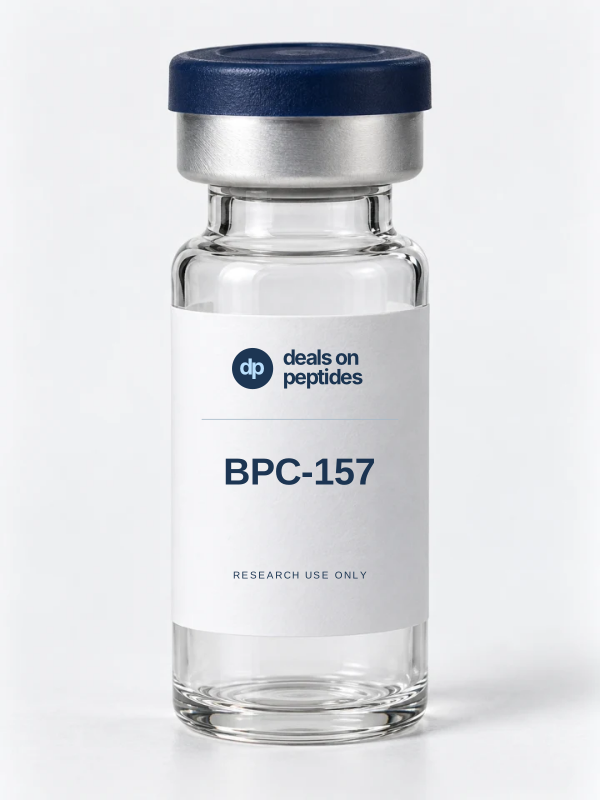
Vial comparison
Compare single-compound BPC-157 research vials by labeled milligrams, vial count and total price.
MATCH SIZE AND QUANTITY
Choose a labeled amount and selection to load matching prices.
GO BEYOND THE PRICE
Select a strength and selection above to view price history, save a price watch or add it to your basket.
DOCUMENTATION PASSPORTS
Inspect the source report, recorded lot and document access. A report link does not confirm the batch currently shipping.
Loading documentation records…
Reported quantities in this family: 1, 2, 3, 5, 6, 10. Counts and units must be matched to the exact listing.
Start with one vial size, such as 5 mg or 10 mg, then check the quantity. The catalog includes both single vials and multipacks. A selection labeled 10 mg × 10 vials contains 100 labeled milligrams; its price per mg divides the total price by 100. You still pay for the whole pack.
Keep BPC-157/TB-500 blends, capsules and atomized-solution kits in their separate groups. The presence of BPC-157 in a title does not make a combination product equivalent to a BPC-157-only vial. For a blend, inspect the amount of each named component rather than treating the total blend weight as BPC-157.
Compare within each strength. Every row covers one vial and includes only listings marked in stock with known quantities.
| Strength | Selection | Lowest listed total price | Price per mg | Supplier count | Compare |
|---|---|---|---|---|---|
| 2 mg | 1 vial | $17.04 | $8.52 | 1 | Compare |
| 5 mg | 1 vial | $19.99 | $4.00 | 18 | Compare |
| 6 mg | 1 vial | $19.79 | $3.30 | 1 | Compare |
| 10 mg | 1 vial | $19.75 | $1.98 | 41 | Compare |
| 11 mg | 1 vial | $27.49 | $2.50 | 1 | Compare |
| 20 mg | 1 vial | $50.99 | $2.55 | 9 | Compare |
| 30 mg | 1 vial | $60.00 | $2.00 | 2 | Compare |

122 products · 249 listings

153 products · 275 listings

20 products · 27 listings
44 products · 56 listings

23 products · 62 listings

26 products · 27 listings
15 products · 20 listings

35 products · 36 listings

25 products · 25 listings
32 products · 41 listings

18 products · 22 listings
20 products · 34 listings

29 products · 143 listings

36 products · 58 listings

34 products · 51 listings

44 products · 62 listings

42 products · 96 listings

22 products · 36 listings

29 products · 39 listings

5 products · 12 listings

24 products · 29 listings

12 products · 14 listings
43 products · 57 listings

20 products · 30 listings

23 products · 26 listings

27 products · 105 listings

40 products · 50 listings

26 products · 42 listings

33 products · 135 listings

28 products · 30 listings

19 products · 24 listings

26 products · 58 listings

18 products · 20 listings

19 products · 25 listings
35 products · 40 listings

34 products · 47 listings

41 products · 52 listings

32 products · 43 listings

37 products · 56 listings

22 products · 29 listings

35 products · 45 listings

16 products · 27 listings

38 products · 47 listings

50 products · 65 listings
39 products · 51 listings

31 products · 35 listings

29 products · 46 listings

18 products · 66 listings

37 products · 58 listings
38 products · 72 listings

30 products · 49 listings
13 listings from direct supplier captures and 85 listings from aggregator reports. Capture and import dates record when data was obtained; they do not guarantee the supplier’s current price or stock.
Listings include out-of-stock and unconfirmed-stock records. Inclusion does not certify a supplier, a batch or a product. Read how matching and source dates work.
Keep them separate. A blend contains more than one named component, and its total labeled weight does not establish the amount of BPC-157 alone. Match the recipe and component amounts when comparing blends.
A larger vial or multipack can have a lower unit price while costing more upfront. Compare the total price alongside price per mg, and use whole-selection quantities when estimating the purchase total.
FROM PEPTIDES CALCULATOR
Source profile reviewed 2026-10-02 · Imported 2026-10-22. Read the full compound profile
BPC-157 (Body Protection Compound 157) is a synthetic 15-amino-acid peptide whose sequence was described by Predrag Sikiric's group at the University of Zagreb as a fragment of a protein found in human gastric juice. It has been studied almost entirely in rodent models of tendon, ligament, muscle, gut and vascular injury, where it is reported to speed healing. Human data are limited to three small pilot studies and one registered phase 1 safety trial that never posted results; it is not approved by any regulator, has been on the WADA prohibited list since 2022, and was placed in the FDA's Category 2 list of bulk substances that may present significant safety risks for compounding in 2023.
A 2025 systematic review of English-language literature identified predominantly preclinical musculoskeletal studies plus very limited human reporting, and noted the absence of strong clinical safety datasets.
Rat Achilles-tendon and tendon-to-bone experiments report improved functional and structural healing markers versus controls in those models; results do not establish human efficacy.
Cell and explant studies describe effects on tendon fibroblast outgrowth, survival under oxidative stress, and migration-related signaling pathways.
Human evidence remains sparse (small pilot / retrospective reports). No large randomized controlled trials establish clinical benefit or a settled safety profile.
Background is reproduced from Peptides Calculator with attribution. The source describes compound-level research. It does not evaluate the identity, quality or suitability of a listed supplier’s product or batch.