MATCH SIZE AND QUANTITY
Build your comparison.
Choose a labeled amount and selection to load matching prices.
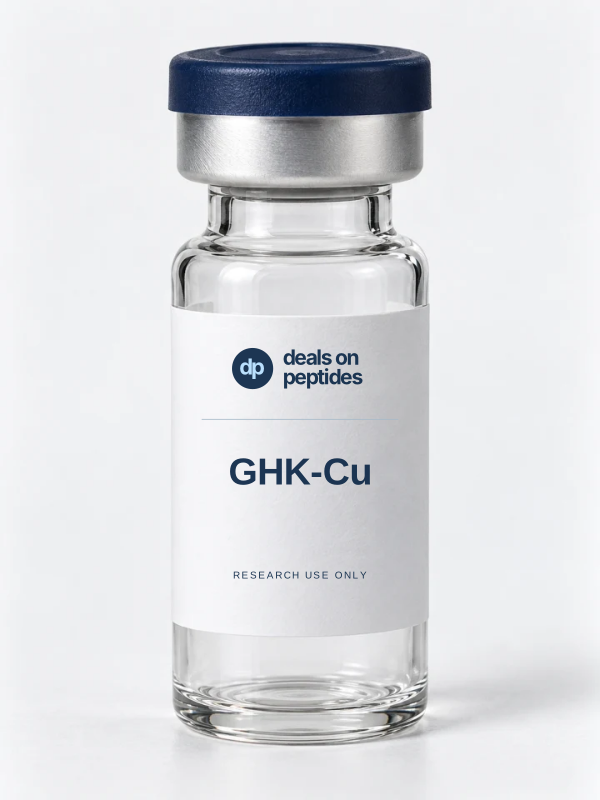
Vial comparison
Compare GHK-Cu research vials within the same labeled amount and selection size. This vial comparison keeps GHK, GHK-Cu capsules and raw powder in separate product groups.
MATCH SIZE AND QUANTITY
Choose a labeled amount and selection to load matching prices.
GO BEYOND THE PRICE
Select a strength and selection above to view price history, save a price watch or add it to your basket.
DOCUMENTATION PASSPORTS
Inspect the source report, recorded lot and document access. A report link does not confirm the batch currently shipping.
Loading documentation records…
Reported quantities in this family: 1, 2, 3, 5, 6, 10. Counts and units must be matched to the exact listing.
The vial catalog includes 50 mg and 100 mg GHK-Cu listings, alongside other sizes. Check whether an offer covers one vial or a multipack before comparing prices. A 50 mg vial and a 100 mg vial have different selection quantities even when their headline prices look similar.
Keep the full product name and format in view. GHK is not an accepted spelling alias for GHK-Cu here. Raw powder, capsules, topical preparations and GHK-Cu/KPV blends also require separate comparisons. A shared GHK-Cu name does not make those formats or recipes equivalent to a single-compound vial.
Compare within each strength. Every row covers one vial and includes only listings marked in stock with known quantities.
| Strength | Selection | Lowest listed total price | Price per mg | Supplier count | Compare |
|---|---|---|---|---|---|
| 30 mg | 1 vial | $35.00 | $1.17 | 1 | Compare |
| 50 mg | 1 vial | $20.00 | $0.40 | 29 | Compare |
| 60 mg | 1 vial | $27.49 | $0.46 | 1 | Compare |
| 80 mg | 1 vial | $25.00 | $0.31 | 1 | Compare |
| 100 mg | 1 vial | $33.99 | $0.34 | 31 | Compare |
| 115 mg | 1 vial | $32.99 | $0.29 | 1 | Compare |

122 products · 249 listings

153 products · 275 listings

20 products · 27 listings
44 products · 56 listings

23 products · 62 listings

26 products · 27 listings
15 products · 20 listings

35 products · 36 listings

25 products · 25 listings
32 products · 41 listings

18 products · 22 listings

4 products · 4 listings

20 products · 34 listings

29 products · 143 listings

11 products · 64 listings

36 products · 58 listings

34 products · 51 listings

44 products · 62 listings

42 products · 96 listings

22 products · 36 listings

29 products · 39 listings

5 products · 12 listings

24 products · 29 listings

43 products · 57 listings

20 products · 30 listings

23 products · 26 listings

27 products · 105 listings

40 products · 50 listings

26 products · 42 listings

33 products · 135 listings

28 products · 30 listings

19 products · 24 listings

26 products · 58 listings

19 products · 25 listings
35 products · 40 listings

34 products · 47 listings

41 products · 52 listings

32 products · 43 listings

37 products · 56 listings
22 products · 29 listings

35 products · 45 listings

16 products · 27 listings

38 products · 47 listings

50 products · 65 listings
39 products · 51 listings

31 products · 35 listings
29 products · 46 listings

18 products · 66 listings
37 products · 58 listings

38 products · 72 listings

30 products · 49 listings
9 listings from direct supplier captures and 90 listings from aggregator reports. Capture and import dates record when data was obtained; they do not guarantee the supplier’s current price or stock.
Listings include out-of-stock and unconfirmed-stock records. Inclusion does not certify a supplier, a batch or a product. Read how matching and source dates work.
No. The index keeps copper-free GHK separate from GHK-Cu. GHKCU and GHK Cu are recognized spelling variants for this group; GHK alone is not.
Those belong in separate format groups. Even when a labeled mass is available, it does not establish that a raw-powder selection, capsule product and vial are interchangeable. Compare the same format and read its quantity details.
FROM PEPTIDES CALCULATOR
Source profile reviewed 2026-10-01 · Imported 2026-10-22. Read the full compound profile
GHK-Cu is the copper(II) complex of glycyl-L-histidyl-L-lysine, a tripeptide first isolated from human plasma by Loren Pickart in 1973 and released from proteins such as albumin and collagen at sites of injury. The copper is held by the glycine amine, the histidine imidazole and a deprotonated amide nitrogen, which is why the complex is described as a non-toxic copper carrier, and its plasma level is reported to fall from about 200 ng/mL at age 20 to 80 ng/mL by 60. Nearly all human evidence is topical: a 1994 vehicle-controlled gel trial in diabetic foot ulcers, a 2006 post-laser study that found no objective benefit, cosmetic cream studies, and a Phase 2 topical wound-gel trial that began recruiting in 2026. Injected GHK-Cu rests on mouse and pig experiments plus clinic and community practice; it is sold as the cosmetic ingredient Copper tripeptide-1 and as a research chemical, was placed in the FDA's compounding Category 2 in 2023 with its status under review again in 2026, and is not named on the WADA list according to the sources below.
A small diabetic-ulcer study reported benefit, while a post-laser split-face trial found no objective improvement.
Wound models report changes in epithelialization, collagen, and inflammatory markers.
Reviews summarize multiple pathways but contain claims not yet validated in controlled humans.
Background is reproduced from Peptides Calculator with attribution. The source describes compound-level research. It does not evaluate the identity, quality or suitability of a listed supplier’s product or batch.