MATCH SIZE AND QUANTITY
Build your comparison.
Choose a labeled amount and selection to load matching prices.
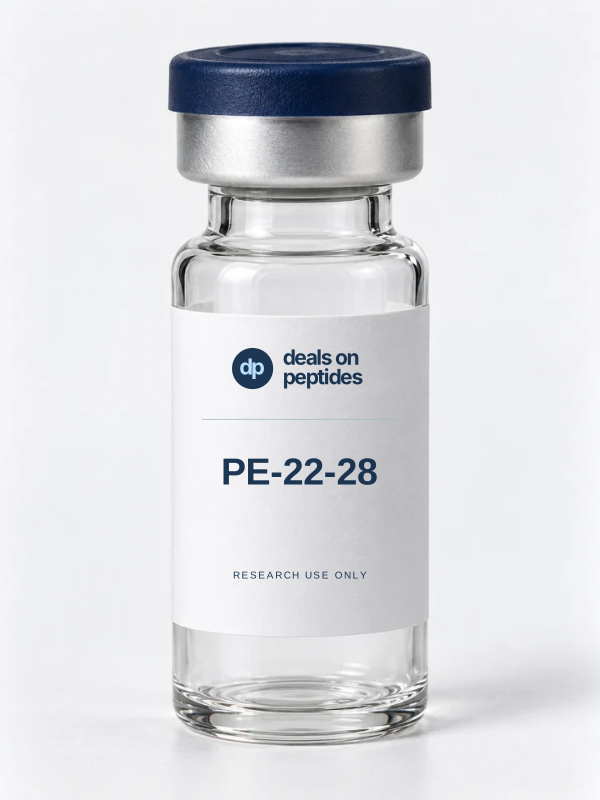
Vial comparison
Compare PE-22-28 listings by strength, selection and supplier. Inspect the original source behind each price.
MATCH SIZE AND QUANTITY
Choose a labeled amount and selection to load matching prices.
GO BEYOND THE PRICE
Select a strength and selection above to view price history, save a price watch or add it to your basket.
DOCUMENTATION PASSPORTS
Inspect the source report, recorded lot and document access. A report link does not confirm the batch currently shipping.
Loading documentation records…
Reported quantities in this family: 1, 10. Counts and units must be matched to the exact listing.
Choose the labeled amount per unit and quantity before comparing. A single unit and a multipack have different upfront prices. Keep product format and exact recipe consistent; similar names do not establish equivalent products.
Follow the original listing to check its quantity, availability and current price. Unit prices use the full labeled mass in each selection.
Compare within each strength. Every row covers one vial and includes only listings marked in stock with known quantities.
| Strength | Selection | Lowest listed total price | Price per mg | Supplier count | Compare |
|---|---|---|---|---|---|
| 8 mg | 1 vial | $60.00 | $7.50 | 2 | Compare |

122 products · 249 listings

153 products · 275 listings
4 listings from direct supplier captures. Capture and import dates record when data was obtained; they do not guarantee the supplier’s current price or stock.
Listings include out-of-stock and unconfirmed-stock records. Inclusion does not certify a supplier, a batch or a product. Read how matching and source dates work.
FROM PEPTIDES CALCULATOR
Source profile reviewed 2026-10-01 · Imported 2026-10-22. Read the full compound profile
PE-22-28 is a seven-amino-acid fragment (Gly-Val-Ser-Trp-Gly-Leu-Arg) of the propeptide released when the receptor sortilin matures, designed in 2017 by Jean Mazella, Marc Borsotto and colleagues at the CNRS Institute of Molecular and Cellular Pharmacology in Nice from the breakdown products of their earlier 17-residue peptide spadin. It blocks the TREK-1 background potassium channel with an IC50 of 0.12 nM, several hundred times more potently than spadin, and in mice it reduced depression-like behaviour, increased hippocampal neurogenesis within 4 days and kept working for roughly 23 hours after a single injection; the same group later reported that very low doses protected mice after experimental stroke while higher doses prevented post-stroke depression. All published work is in mice and cultured cells using intraperitoneal injection or oral gavage; there is no human study, no registered trial and no approval, and the intranasal spray favoured by the research-peptide community has never been tested in any species.
Understanding TREK-1 and therapeutic applications
Background is reproduced from Peptides Calculator with attribution. The source describes compound-level research. It does not evaluate the identity, quality or suitability of a listed supplier’s product or batch.